
From Constantine to Trump: Christianity is a Religion of Empire
The Revolutionary Jesus Was Always the Cover Story

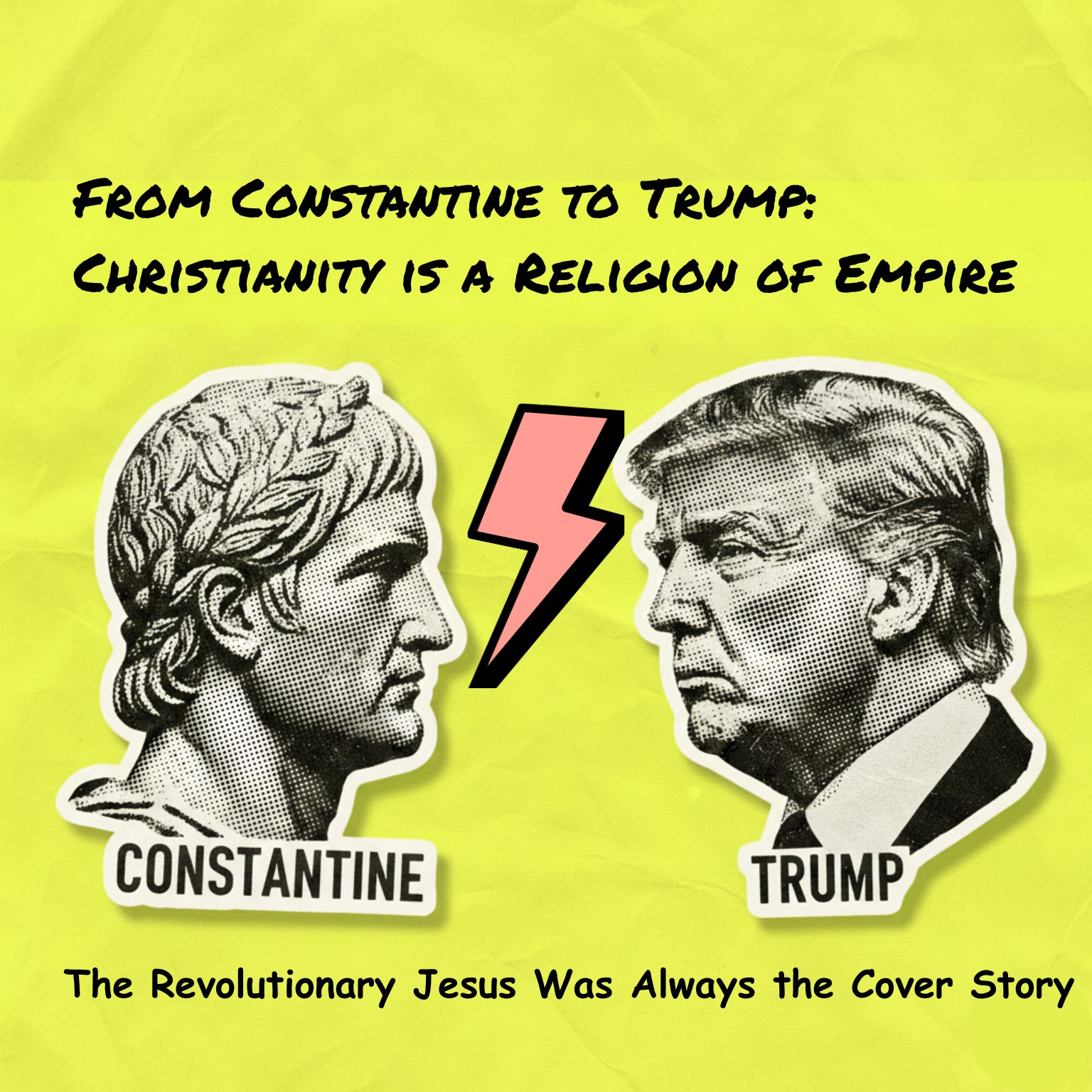
Christianity has a Jesus problem. The figure at the center of the faith — itinerant, propertyless, executed by the state for threatening the established order — bears almost no resemblance to the institution built in his name. That institution has blessed crusades, colonized continents, built boarding schools to destroy indigenous children, and, in its American form, become one of the most reliable constituencies for military power and authoritarian politics. The peasant rabbi became the emperor’s chaplain, and he has never retired from that role. What if the story of the humble, revolutionary Jesus was never the point — but always the alibi?
The Religion Jesus Never Founded
Growing up, my Jewish dad used to tell me, “You know, when I went to church with your mom, there was always at least two Jews, me and the guy hanging on the cross.” At the time, I just thought my dad was being provocative. I now understand he was making a factual point — the historical Jesus was not a Christian. This is not a provocative claim — it is the consensus of contemporary New Testament scholarship. Scholars like John Dominic Crossan and Marcus Borg have spent careers reconstructing the figure behind the theology, and what emerges is a Jewish peasant reformer operating entirely within Second Temple Judaism. He taught in synagogues, observed Torah, and directed his message almost exclusively at fellow Jews living under Roman occupation. He had no interest in founding a new religion. He was trying to renew an old one.
Christianity, in any institutional sense, is the creation of Paul of Tarsus. Paul’s letters are the earliest documents in the New Testament, predating the Gospels by decades, and the Christ Paul preaches is already a fundamentally different figure than the Jesus of the Sermon on the Mount. Paul’s Christ is a cosmic redeemer whose death atones for universal human sin — a theological framework with almost no grounding in anything Jesus actually taught. Paul was not transmitting Jesus’ message. He was building something new on top of it, shaped by his own Greco-Roman context and the organizational demands of communities scattered across the empire.
At this point, a good evangelical will reach for their Bible. Instinctively, they’ll go somewhere like Matthew 28:18-20, the Great Commission, and argue this text seems to settle the matter:
“Go and make disciples of all nations, baptizing them in the name of the Father and of the Son and of the Holy Spirit.”
There it is, they will say — clear as day, Jesus himself commanding a universal mission. Acts 1:8 makes it even more explicit:
“You will be my witnesses in Jerusalem, in all Judea and Samaria, and to the ends of the earth.”
A global institution spanning empires sounds less like a corruption of Jesus’ intent and more like its fulfillment.
The problem is that contemporary scholarship has serious questions about whether Jesus said either of these things. The Great Commission appears only in Matthew, the latest of the Synoptic Gospels, and critical scholars widely regard it as a composition of Matthew’s community rather than a traceable saying of the historical Jesus. It reads less like something a Jewish peasant preacher said on a hillside and more like a mission statement retrofitted onto the resurrection narrative by a community already committed to Gentile outreach. Bart Ehrman, hardly a fringe voice — like me, he’s a former evangelical, and unlike me, he is now one of the most widely read New Testament scholars in the world — has argued extensively that the Gospels reflect the theological concerns of the communities that produced them as much as they reflect the historical Jesus. Acts presents an even clearer case: written by the same author as the Gospel of Luke as a two-volume work, it is essentially the founding narrative of the Pauline church, mapping Paul’s missionary journeys across the Roman world and reading divine intention back onto them. “To the ends of the earth” is not a prophecy. It’s a description of where Paul already went, dressed in the words of Jesus.
This is the pattern that runs through the entire New Testament: the concerns of later communities, already shaped by Paul’s theological agenda and the practical demands of Gentile mission, written back onto the figure of Jesus. The Gospels, written after the destruction of the Temple in 70 CE, are themselves already institutional documents — produced by communities under pressure, working out questions of identity, authority, and membership. They are community formation texts, and they bear the marks of communities that were already moving away from their Jewish roots and toward something that could survive and spread in the Roman world. By the time the canon is assembled, the revolutionary Jewish peasant has been transformed into the universal savior of a new religion — one far better suited to empire than anything Jesus preached from a hillside in Galilee.
None of this is to say Jesus was good and Paul was bad. It is to say that the institution of Christianity was never built on the actual teachings of Jesus. It was built on a theological interpretation of Jesus, developed by someone who never met him, optimized for a world of urban Gentiles and imperial infrastructure. The revolutionary is already becoming respectable before Constantine arrives. The emperor didn’t corrupt the church. He just completed the work Paul started.
Constantine Didn’t Convert to Christianity — Christianity Converted to Empire
In 313 CE, Constantine issued the Edict of Milan, granting Christians religious tolerance across the Roman Empire. The church remembers this as a moment of liberation — the persecuted community finally free to worship openly. What actually happened was more consequential and far less flattering. Christianity didn’t just gain tolerance. It gained a patron, and patrons always have expectations.
By 325 CE, Constantine convened the Council of Nicaea to resolve theological disputes that were fracturing his empire. Note what is happening here: an emperor is summoning bishops to settle questions of doctrine.
The authority to define orthodox Christianity flows not from the teachings of a peasant rabbi but from the political needs of a Roman emperor who needed a unified religion for a unified empire.
As one historian put it, the age of Christian emperors was an age of creeds, and creeds were the instruments of conformity. The Nicene Creed is not a grassroots confession of faith hammered out by communities discerning together. It is state doctrine, enforced by imperial power, with dissenters exiled.
The theological architecture built at Nicaea didn’t just define what Christians believed — it defined who had authority, who was heretical, and crucially, who had the backing of the state. Eusebius of Caesarea, the imperial court’s favorite bishop, essentially invented Christian political theology to justify the arrangement. In his writings, Constantine is portrayed as a divinely ordained ruler — a “delegate of the Supreme” and “interpreter of the Word of God” — and the Roman Empire itself as the earthly fulfillment of God’s kingdom. He practically convicts himself. This is not the theology of someone trying to renew a Jewish peasant movement. This is the theology of someone building an imperial religion from the ground up.
The template Eusebius established proved extraordinarily durable. Church authority and state power would remain fused — sometimes contentiously, always consequentially — for the next seventeen centuries. Crusades launched with papal blessing. Inquisitions backed by royal force. The church didn’t just benefit from empire. It became empire’s most effective legitimating institution, providing the sacred story that made conquest feel like providence. The emperor’s chaplain had found his permanent office.
The New World as Proof of Concept
When Christopher Columbus made landfall in 1492, he did not arrive alone. The cross and the sword traveled together — this was not incidental, it was constitutional.
The Doctrine of Discovery, a legal and theological framework built on a series of papal bulls issued in the 15th century, declared that any land not inhabited by Christians was available to be claimed, conquered, and exploited by European powers. The church did not merely bless this arrangement. It authored it.
Colonial conquest was not something Christianity was recruited to justify after the fact. It was something Christianity provided the ideological architecture for in advance.
In North America, the same logic produced the Indian boarding school system, explicitly designed, in the words of its architect Richard Henry Pratt, to “kill the Indian and save the man.” These were not fringe operations. They were funded by the federal government and run predominantly by Christian denominations — Catholic, Methodist, Presbyterian, Episcopal.
The goal was civilizational erasure dressed in the language of salvation. To be saved was to be made white, English-speaking, and Christian.
The three were functionally synonymous. Roxanne Dunbar-Ortiz, in her essential history of the United States, shows how this was not a corruption of the American Christian project but its fullest expression — the missionary impulse and the colonial impulse were always the same impulse. This definition of salvation is still alive and well today. In my own social networks I regularly come across Pro-Trump Latinos, Mexican-Americans working their hardest to emphasize their American while rewriting or ignoring their Mexican. Call them Spanish, Texican, or Hispanic, anything but Mexican. Their American-ness is confirmed by their embrace of white culture, white values, and more often than not, a nationalist Christianity that has no room for the Mexico their families came from.
Manifest Destiny was theology before it was policy. The phrase itself, coined in 1845, was saturated in providential language — God had ordained Anglo-Protestant civilization to spread from sea to sea, and anyone standing in the way was standing against divine will. This is Eusebius in a new world. The logic is identical: empire and church as co-heirs of God’s plan for history, conquest reframed as providence, violence sanctified by doctrine. American Christianity did not import this logic from a corrupted European church and then try to do better. It inherited the logic, refined it, and put it to work on a continental scale.
The Revolutionary Jesus Was Always a Cover Story
Christianity has always produced reformers. It cannot seem to help itself. From the Anabaptists of the 16th century who rejected state churches and refused to bear arms, to the Social Gospel movement of the early 20th century that tried to aim the institution at poverty and inequality, to the liberation theologians of Latin America who read the Gospel as a mandate for revolution, the history of Christianity is littered with movements that looked at the institution and said: this is not what Jesus meant. They were right. And they all failed to change it in any fundamental way.
This is not a coincidence. It is a diagnosis.
The reform impulse keeps returning because the gap between what Christianity claims to be and what it actually is remains undeniable to anyone paying attention.
But reformers almost universally make the same mistake: they assume the institution was built on the teachings of Jesus and has since been corrupted, and that the task is to strip away the corruption and recover the original. What this piece has tried to show is that there is no original to recover.
The institution was not corrupted. It was constructed — by Paul for the Greco-Roman world, completed by Constantine for the Roman Empire, and exported by European powers to every continent they colonized. The revolutionary Jesus was always the alibi, not the architect.
This is what makes Christian nationalism in its current American form so clarifying. When Donald Trump held a Bible aloft in front of a church cleared by tear gas, the outrage from mainstream Christians missed the point entirely. They saw desecration. What they were actually watching was the mask coming off — the imperial character of the institution made visible without the usual theological dressing. Christian nationalism did not corrupt American Christianity. It just stopped being polite about what American Christianity has always been: the sacred language of empire, the liturgy of conquest, the chaplaincy of power.
The reformers will keep coming. Some of them will be admirable people doing genuine good in the world. But as long as they are trying to reform an institution back toward something it was never built to be, they are not solving the problem. They are providing the institution with its most useful alibi of all — the proof that it contains multitudes, that it can self-correct, that the revolutionary Jesus is still in there somewhere, waiting to be recovered. He isn’t. He can’t be. Because he was never part of the system. He was a Jewish peasant reformer who never intended any of this. The institution built in his name has known that from the beginning. The rest of us are only now catching up.
Hey Rebel is supported by mutual aid sustainers, not paywalls. If you have the means and want to keep this work accessible for everyone, consider contributing on Ko-fi. Solidarity means no one gets left behind.
Awesome! Thanks for saying it clearly and out loud.
Love it! Well written😊